Wednesday, March 2, 2016

You can face your Social Anxiety using Exposure Therapy

If you ever have experienced social anxiety, then you know just how difficult and challenging it can be to find yourself in social situations. However, a key factor to being able to overcome your fears is being able to face them. You can face your anxiety through a technique known as exposure therapy. Exposure therapy, simply put, incorporates the act of exposing yourself to the feared situation or anxiety inducing situation and learning ways of overcoming the fear. Exposure therapy is clinically proven to help individuals overcome fears and anxiety.  Below are some tips to aid in the process of exposing yourself to assist in overcoming anxiety: 

You can begin by identifying your catastrophic belief related to your anxiety. Your catastrophic belief is your belief associated with the anxiety inducing situation, that overestimates the likely hood of a negative event to occur. Most often, people with social anxiety overestimate the degree to which others are evaluating and criticizing them. Furthermore, they believe that they are unable to cope with the criticism, rather it be real or imagined criticism. 

Try the gradual exposure approach. This can be done by breaking down your fears into a series of steps, starting with mildly challenging steps and increasing in difficulty.  You can do this by creating a list of situations which elicit anxiety or fear and then number how much distress you would feel if you were in each situation. Then rank each situation from the least distressing to the most distressing situation. The first exposure attempt should be difficult enough to induce some anxiety but easy enough that you feel able to complete it. It is extremely important as to not try and confront a very difficult/feared situation to soon, because you have the potential to become overly anxious which can induce a panic attack. A negative experience such as this, would only strengthen the connection between the fear and the setting.

Repeat, Repeat, Repeat. A key factor to overcoming your anxiety is to repeatedly place yourself in the same situation until you feel very little to no anxiety inducing distress from the situation. This means placing yourself in the situation frequently enough to become habitual. If your exposures are too far apart your fear will rise again by the next time you attempt the exposure. 

Prolong the exposure. Another key factor to ensuring effectiveness of the exposure is to remain in the situation until your anxiety level decreases. It is very common behavior to want to escape the situation the moment the fear or anxiety appears. However, when we leave or avoid an anxiety inducing situation we will further strengthen our belief that the situation causes anxiety. Furthermore, due to the decrease in anxiety once out of the situation, we come to believe avoidance to be a helpful strategy. However, by staying in the situation until our anxiety decreases, we actually help ourselves to feel less anxiety when confronted with the same situation again. 

As we find ourselves in anxiety inducing situations, it is important to remember to remain in the situation until the anxiety has decreased, as this is an important aspect in being able to overcome the anxiety. However, if you feel your anxiety level is too high, you may find that you will benefit from taking a timeout from the feared situation. 

For example, if you were attending a wedding you can choose to either step outside for a moment or break away to the bathroom. During your timeout, you can allow yourself time to think over the situation and rationalize the anxiety. Remember what your catastrophic belief is and think about how it may be effecting your ability to overcome the situation. Try some deep breathing or other therapeutic stress reduction exercises if needed. Once, you feel less anxiety, you can then go back to the wedding. Keep reminding yourself of your goal and how essential the exposure is to your ability to overcome. 

Written By: Lara Pomnitz, graduate level intern.

Edited by Charity Loring, LMSW Loring Therapy, LLC http://www.loringtherapy.com/

Thursday, October 29, 2015

Communicating effectively - Stop. Think. Talk. Listen. Resolve.

Communicating effectively
Stop. Think. Talk. Listen. Resolve.
Communication is essential to building healthy relationships. When trying to convey an important message or discuss a difficult topic, how we deliver the message can affect how it is received. Below are some useful tips to consider when communicating:
Face it. When having a serious talk it is important to conduct your conversation face to face. It may be best to avoid sending emails, text messages or writing it down because written messages can often be misinterpreted and the person may miss the message you are trying to convey. 
Timing. Is there something important you would like to discuss with your partner, boss or friend? When wanting to have a serious conversation it is imperative to find the right timing to bring up your thoughts and feelings. For instance, if you are upset with your spouse, it is probably not best to have a serious conversation when they are getting ready for bed or appear stressed after a bad day at work. It may also not be best to attempt to have a serious conversation with your boss when you are in a meeting with other employees. Instead, share with your spouse or boss that you would like to talk and find an appropriate time to share. 
Avoid Attacking. When a person feels they are being attacked they will often shut down all lines of communication and go into defense mood. Remember your goal is to resolve the problem and not prolong the issue or make things worse. Be careful of the words you choose to avoid the person feeling attacked. For example, try using words such as “I” or “we” versus “you”. 
Stay Humble. No one is perfect, so we cannot expect others to be. Instead, remain open and honest with your feelings. Don’t be afraid to apologize instead of making excuses if you made a mistake. Being humble can help you to feel better about yourself and further strengthen your relationship. 
Watch your Movements. Be aware of your body language when speaking to others. Notice your posture and your use of eye contact. Are you looking away from them when you speak? Are you slouching down? These non-verbal forms of communication indicate signs of passivity and insecurity. Instead, make eye contact when speaking and sit-up or stand up straight. Show your confidence behind your words, as well as demonstrate that you listening. Don’t play with your phone or take calls when having an important conversation. 
Stop. Think. Talk. Listen. Resolve. When you are angry it is especially important to take extra precautions when communicating. Stop and take a step back and allow yourself the opportunity to cool down. Think about why you are upset? Can the situation be resolved? When you are ready, talk it out. Listen,  allow the other person the opportunity to share. Resolve - Apologies aren’t enough, resolve how the two of you will handle things differently in the future.
Using these tips may help us to open the lines of communication. Thus, strengthening the relationships we have. Try it out!
Written By: Lara Pomnitz, graduate level intern.
Edited by Charity Loring, LMSW Loring Therapy, LLC http://www.loringtherapy.com/

Adapted from:                                                                                   .

Thursday, October 1, 2015

Appreciating You - It's not Selfish, it's Self Preservation

How many times a day do you tell yourself, “Wow, I am so awesome!?” Probably not enough. On the other hand, how many times can you recall thinking, “I’m so stupid”, or “I can’t do this”? Negative self-talk can be self-defeating and can take a big toll over our emotional-wellbeing. 
An example of negative self-talk would be telling yourself “I’m not smart enough to get this job”.  Telling yourself this may prevent you from applying. When we feed ourselves negative talk we limit our possibilities.  Furthermore, negative self-talk can leave us feeling depressed, anxious, angry or upset. The first step to appreciating you, is to challenge your negative thinking. 
If you wouldn’t say it to someone you love, don’t say it to yourself. Would you tell someone you love “you are so stupid” or “you can’t do anything right”? Probably not. How do you think that would make them feel? Hurt, angry, upset? When we make negative comments like “I can’t do this” or “I’m not good enough”, we are in turn hurting our own feelings and damaging our own emotional-wellbeing. Instead of negative talk, ask yourself what would someone I love say to me?
Try it out:
Take a moment to reflect on the past week and identify a time where you found yourself feeling bad about yourself. What did you tell yourself? (Write this down) Now, what do you think a loved one you respect would tell you about what you wrote? (Write this down)
  • Example: You say: "I completely messed up that project, I am such a failure" . Your loved one says: “You may not have done as well as you would have liked, but that does not make you a failure”.
Embrace your imperfections. Free yourself and let go. Make a mistake, learn from it  and move on. But don’t forget to smile because you are imperfect like everyone else, but you are also unique and full of strengths as well.

Written By: Lara Pomnitz, graduate level intern.

Edited by Charity Loring, LMSW Loring Therapy, LLC http://www.loringtherapy.com/


Thursday, September 17, 2015

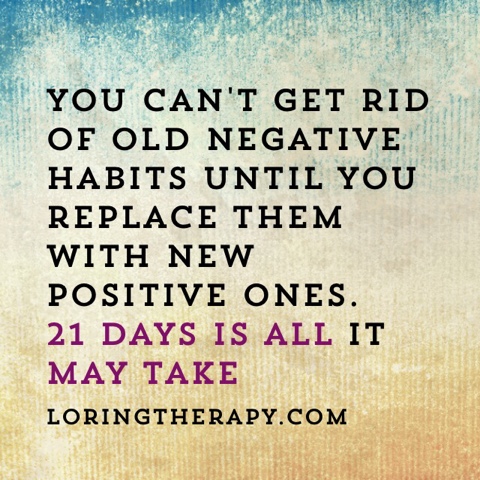
Forming New Positive Habits can replace old Negative Habits

Have you ever decided you wanted to do something to improve yourself but just didn’t know where to start? How many of us have struggled to follow-through with a new goal? The key, rests within our own conscious minds. Think for a minute, have you ever told yourself “From now on, I’m going to start going to the gym!”, or “Todays the day I’ll quit smoking!” How many of us actually succeed? To work towards ridding ourselves of old negative habits, we need to replace them with new positive habits. Research suggests that it takes a minimum of 21 days to form a new habit. For example, if you want to start a habit of walking daily, tell yourself “I’m going to walk every night, for 30 minutes for the next 21 days”. Research shows that if you carry-out your new habit for 21 days in a row, you are more likely to continue even after the 21st day.
Below are some positive habits to give a try: (Remember the key is to carry-out your new habit for 21 days in a row)
  • Take 3 minutes each day to contemplate everything you are thankful for.
  • Take 5 minutes each day to practice deep breathing.
  • Take 10 minutes a day to consider options to a problem then take action towards finding a solution.
  • Take 15 minutes each morning to meditate before you start your day.
  • Spend 10 minutes outside each day to appreciate the beauty surrounding you. 
  • Perform one small act of kindness for someone else every day.
Keep in mind that we’re all different and some of us may take longer to form a new positive habit and some of us may take less. So don’t beat yourself up if you fall off track, get back up and keeping moving!
Written By: Lara Pomnitz, graduate level intern.

Edited by Charity Loring, LMSW Loring Therapy, LLC http://www.loringtherapy.com/

Wednesday, July 22, 2015

Why take a Solo Trip?

Why Take a Solo Trip?
I will admit there is nothing like traveling with others for camaraderie. Human connection and shared experiences have a magic all their own.

But traveling alone has a unique magic to it as well. It brings about:
1. Balance
2. Your own version of fun.
3. Heightens the mind with Problem solving skills and Critical thinking. 
4. Let's you get to know yourself and the world around you better.

Sure it gets a little lonely and your mind tends to wander to others sometimes... But for me, the good outweighs the bad.

The Good:

Balance
When else do you have multiple days to please no one but yourself? You get to move at your own pace the entire time. No rushing and no worrying about another persons timeline. You get to luxuriate in laziness and get motivated by things you truly want to explore. Sometimes you get tired of the laziness, sometimes you get tired of the exploring, so then you learn how to balance it all out.

Your own version of fun.
You may not even know what your own version of fun is. And that's perfectly OK. You may be used to traveling with others and doing things that they would like to do or finding compromises. There's nothing wrong with that with those things. But when you travel solo, you truly get a sense of what you enjoy doing, so then you start to learn your own version of fun.

Heightens the mind.
Traveling by yourself makes you more aware of your feelings and thoughts. Sometimes people want to escape these two things by getting lost in distraction. But really, if you don't have anyone else to vent to, or every day life to get in the way, you are faced with resolving those thoughts and feelings so you can then go about enjoying your trip.
Traveling alone also heightens your critical thinking skills. You become a lot more resourceful and creative when you have only yourself to rely on. In essence, traveling with yourself makes you learn more about, well,  yourself.

Getting to know yourself and the world around you better.
Solo Trips make you more aware of your  surroundings...
The quaintness of small towns, the emotions you have when they are stirred by the lyrics and sounds of your favorite music, the wind in your hair, the wildlife chattering and scurrying about you, the friendliness of a smile, or a hello (that you experience often while camping and hiking), children's laughter, annoying car alarms, old men that meet in groups for breakfast and talk mostly about observations but rarely discuss  feelings, women that meet one on one for lunch that talk mostly about their feelings with a small smattering of observations, couples who are opposites, couples who are alike, the friendliness of people who are in the present moment with you and rudeness of people who are lost in their own heads and egos and won't be there with you and self awareness of how you choose to feel and react to friendliness and rudeness. 

We have all tricked ourselves into thinking that we should not travel alone. Some concerns are safety (which can be addressed with realistic planning), fear of the unknown, and thinking that it can't be enjoyed unless others are around. But don't take my word for it, experience a solo trip yourself and see what happens.

Author- Charity M. Loring, LMSW


Thursday, May 21, 2015

Parentification- AKA- Parentified Child

Form of role reversal, in which a child is inappropriately given the role of meeting the emotional or physical needs of the parent or of the family’s other children.

Backlash: Due to being treated like an adult, the child will not be able to relate to peers as a child. Not relating to peers can continue into adulthood. The child will be forced to make their own rules in an immature state due to lack of parenting. The rules they create do not integrate well into society leaving the child to consistently feel like an outsider. 
The child is at high risk in developing explosive anger or withdraw, control issues, neglecting their own emotional needs, severe trust issues,  lack of coping skills (due to the lack of being taught proper coping skills by a parent and having to develop them on their own), lack of developing close emotional relationships, depression, anxiety, social anxiety and suicide. These issues continue to follow the child into adulthood if not treated by a licensed Therapist.

Author: 
Charity M. Loring, LMSW
Loringtherapy.com

Thursday, May 7, 2015

What is the difference between Hypnosis and Hypnotherapy? Think of a Dandelion…

Hypnosis - A state of consciousness where your conscious mind and subconscious mind are working together.The Induction is a format of getting to that state of consciousness. You enter this state of mind naturally throughout your day when you are daydreaming or maybe driving on the highway thinking of something subconsciously but you are still conscious enough to drive. Hypnosis has temporary effects as a Hypnotist has no formal education in being a licensed Therapist.

Hypnotherapy - Combines the power of Hypnosis with a Licensed Clinical Mental Health Therapist who has the proper training and knowledge to provide therapy to the client in a focused and open state of using the conscious and subconscious. Hypnotherapy helps you connect with your genuine need and designs an effective strategy to fulfill that need. 


Dandelion Analogy - Your bad habit or life problem is like a dandelion in your yard. Trying to solve it with hypnosis is like pulling off the top of the weed and leaving its roots in the ground. For a time, you won’t see a dandelion in that spot on your lawn, but as the rain falls and the sun shines, that dandelion will grow back. Hypnotherapy is like digging out the weed by its root so that it will never grow back again.